
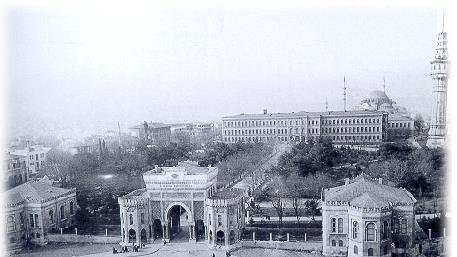
History of Istanbul University
Historical Overview of Istanbul University
There are different academic perspectives regarding the historical origins of Istanbul University, which sits at the intersection of Byzantine and Ottoman scholarly traditions. German legal historian Richard Honig traces the history of the university back to March 1, 1321, stating that an institution of higher education comparable to Roman universities—comprising faculties of medicine, law, philosophy, and literature—existed on the hill where today’s main building is located. This view represents a scholarly perspective that situates the beginning of university education in Istanbul within the Medieval period.
Turkish researchers, on the other hand, place the origins of Istanbul University in 1453, immediately following the conquest of Istanbul. The scholarly meetings held in Hagia Sophia and Zeyrek on May 30, 1453 are regarded as the institutional starting point of Turkish-Ottoman scientific life, forming the foundation for the construction of a külliye in the following period. Sıddık Sami Onar emphasizes that, because the Turks did not find an existing university in Istanbul, they developed a higher education institution aligned with their own civilizational values. Similarly, Cemil Bilsel states that the foundation of an academic structure in medicine, law, science, and literature began with the establishment of the Fatih Külliye in 1470. Soviet medical scholar Danishefsky’s assertion that one of the world’s oldest medical faculties existed in Istanbul provides international support for this historical framework.
During the Republican period, Istanbul University underwent structural reforms under the New Universities Law No. 1750, dated June 20, 1973, coinciding with the 50th anniversary of the Republic. With the complete replacement of Law No. 4936, the Higher Education Council was established, and major universities were tasked with meeting inter-university academic staffing needs. Istanbul University fulfilled this responsibility to a significant extent, contributing greatly to strengthening academic cadres across Türkiye.
Today, Istanbul University operates within the framework of the Higher Education Law No. 2547 dated November 6, 1981, continuing its historical, social, and scientific mission based on a contemporary, progressive, and secular understanding of education. The institution’s emblem featuring intertwined serpents was inspired by motifs from the Seljuk Healing Center dated 1243 and designed by Prof. Süheyl Ünver, symbolizing the university’s deep historical roots.
One of the most significant milestones in the history of the Republic, the 1933 University Reform, transformed Istanbul University into Türkiye’s first modern university in line with Atatürk’s vision. Various educational systems had been implemented within the Ottoman Empire until the early 19th century; however, Atatürk asserted that the madrasa system no longer met the needs of modern society. Through the Law on the Unification of Education, all religious education institutions were closed, consolidating the national education system under the Ministry of National Education. The 1933 reform provided universities with a modern scientific structure.
The foundation of the Istanbul University Faculty of Business Administration, however, lies in the Institute of Business Economics, established in 1954 within Istanbul University by Harvard Business School, which still continues its graduate education activities today. This institute pioneered modern business education in Türkiye and introduced an internationally oriented academic perspective.
As Türkiye’s first Faculty of Business Administration, the Faculty began its academic activities on April 11, 1968 in Beyazıt; moved to Rumelihisarüstü in 1983; then to its building on the Avcılar Campus in 1989; and finally to its current building in Avcılar in 2016, where it continues its operations.
